Showing posts with label books. Show all posts

Tuesday, April 6, 2021

National Library Week 2021

April 5 through April 10 is National Library Week!


Take the time to visit a library - PLEASE WEAR A MASK INSIDE A LIBRARY AT ALL TIMES - and check out what you like - BOOKS ARE GOOD, WE GOT A BUNCH ON HAND - and support literacy and community resources to the full - WE MIGHT BE NEAR DOG PARKS, YOU NEVER KNOW.

In the meantime, see if you can spot a fool in this crowd:

I know I overdo the arched eyebrow thingee

NOW GO READ! We'll see you in the summer when our family events take place.


Sunday, June 4, 2017

Why My Book Covers Will ALWAYS Be Blue

The dread secret at last revealed.

lean in, let me tell you...

...closer...

...closer...

(looks askance for a moment)

'CAUSE IT'S MY FAVORITE COLOR, FOOL!

NOW BACK TO WORK ON WRITING THIS DAMN BLUE BOOK!

Thursday, December 22, 2016

Witty's Year End Book Review 2016

To the many readers following this awesome blog - okay, eight of you plus the Chinese and Russian Spammers who keep hitting this web address 34 times every 4 hours, what the hell - it's time again for a review of the works I've read and which I want to say Damn THIS is Good Give It A Try.

As always, the rules are 1) It's not what's new that I've read, merely something I've read this year that counts. It could be a book from 1978 of my youth I've revisited for some reason. 2) It's something you ought to get at your local library (SUPPORT ALL LIBRARIES WOOT).

So, that said, here's the list for 2016.

BEST FICTION

Angelmass, Timothy Zahn

Already a fan of Zahn's work on the Star Wars literary 'Verse (shunted off now that it mostly conflicts with the Disney control of LucasFilm), I picked up this work for ebook reading a few years ago and spent some time here and there perusing it.

Zahn sets up a galaxy-spanning human empire (Pax) in conflict with another race in the Seraph solar system that has developed a bizarre new technology: harvested materials ejected from a Black Hole - yes, it's possible - that are used to create "angels", baubles that compel the wearer to be honest and virtuous. The moral implications alone are staggering, but Zahn's main characters - sent to confirm the science (and to justify Pax sending a warship to destroy the Seraph system) - also have to cope with the truth behind Angelmass, along with the ramifications of a galaxy-wide war that would erupt should their own Pax armada succeed in starting (not finishing) the impending war.

Where Zahn impresses me is with the creative and memorable characters he creates for his works: their interactions throughout most of the stories he writes make his stuff enjoyable reads. This one isn't as good as his Thrawn Trilogy, but as a stand-alone Sci-Fi novel it's a solid work.

BEST NON-FICTION

Pragmatism, William James

While I'm not a fan of -isms (per my political blogging), I still recognize that I have a world-view and that I have to find some way to cope with it all. As such, I'm really getting into reading up on Pragmatism as a philosophy, and I've been reading the works of William James over the last three-four months.

What I'm getting into with James' take on Pragmatism: He argues about Reality in which you have to deal with matters of fact (not so much Truth Of Opinion but Truth of Fact), with ideas that must relate to each other, and that these truths must lead us to useful consequences (that Pragmatism must lead to practical, long-term solutions). As a librarian who performs research into facts, and works on goal-oriented projects, I get the feeling I've been playing by these rules most of my life.

I'm still in the middle of reading this stuff, but if I had to ever go with an -Ism to follow I'm gladly buying into this.

BEST GRAPHIC NOVEL

Black Panther: A Nation Under Our Feet, Ta-Nehisi Coates

Granted, I'm a fan of Coates' political and historical writings already, but I'm now a fan of his fiction writing in the comic book literary style. (and DAMN, he's living the dream doing it...)

As part of a Marvel Universe reboot, the company granted Coates the chance to start a new series of one of the major African (American) superheroes in their roster. What Coates did was re-establish Black Panther's political and cultural legacy, by questioning the role T'Challa has as both king and guardian of a powerful African nation now beset by uprising and turmoil. Dragging in the real-world problems that Africa has with terrorism, human trafficking and human rights, and political animosities across borders, Coates tweaked a place with a comic-book history (he's notably building off the work done famously by Christopher Priest) by giving it a genuine conflict that can't be easily resolved within six issues of a monthly release. Coates is signed up for twelve issues (of which 8 is out and this graphic novel collecting the first part of the story arc), so it'll be interesting how he wraps this up.


BEST WORK BY SOMEONE I EMAIL, TWEET, or CHAT WITH ON A REGULAR BASIS

Death Vigil Volume I, Stjepan Sejic

Okay, I'm cheating a bit here by going with another graphic novel, but the rule is "someone I email, tweet, or chat with on a regular basis," and I've kinda tweeted enough times with him - "you did WHAT? With a WHAT?! To a WHAT?!?!" - regarding his other work Sunstone that this qualifies (I kid: I have no problem with (expletive deleted) being used as part of (unusually detailed sexual shenanigans), just as long as it doesn't harm any Presbyterian choirs...!).

Death Vigil, from what I gathered about his working on the project, is more of a personal labor of love for Sejic than anything else. Drawing from his work with Witchblade and on the shared geek concept of Eldritch monsters, Sejic creates a world where death is only part of our problems. Your soul can get used and abused even after you die, and your best chance for your soul to survive is with a team of Knights who work as Reapers/Monster-fighters. Introducing us via a recent cult victim's entry to the ranks of these Knights, we meet a rather lively (pun intended) group of dead people, who are facing a dire threat from humans working with demonic forces to seize the weaponry of these Knights in a mad attempt to cheat death itself.

What makes DV fun amidst the terror is how Sejic creates memorable, interactive characters that we can root for. In particular, he introduces us to Mia an otherwise happy-go-lucky preteen girl who just happens to be a Lovecraftian monster outside of her human form (who's still happy-go-lucky even as she's devouring her enemies).

While Sejic is tied up with other projects - he's capped Sunstone at five volumes but now working on related spin-offs - he's still eager to give Death Vigil one more volume to finish off the ideas he's got in that 'Verse. You ought to give Volume I a serious look.

BEST ANTHOLOGY THAT CONTAINS A STORY I WROTE

Strangely Funny III, Mystery & Horror LLC

If you'll recall an earlier submission to Strangely Funny, I wrote a story "I Must Be Your First" about a vampire coping with the problem of Hunters ruining his morning. Coming off from that, building on a 'Verse where I have rules about what vampires really are and about the other supernatural elements they cope with, I submitted this little tidbit "Minette Dances with the Golem of Albany." Sort of a prequel set in 1985 where a vampire (actually a dhampyr, a half-human blood drinker) spends a night dancing (kind of) with a Golem sent to kill her. I had fun messing with the rules of Golems as much as with vampires, and set up how a Golem is actually the perfect opponent against otherwise unstoppable vampires (vamps can't drink from a Golem, and Golems are stronger and more unstoppable than vampires).

I chose having the Golem come from Albany Georgia because 1) Georgia is known for the red clay, and clay is a good material for Golems and 2) that's my birth city. Yay.

I haven't seen as many reviews for my story, nor for the anthology, but I hope my readers here pick up the book and give it good thumbs up, please and thank you.

Shill shill shill. ;-)

So, that said, IO SATURNALIA and HAPPY NEW YEAR!


Tuesday, December 22, 2015

Witty's Year End Book Review 2015

Getting down towards the moment where I want to mention the stuff I've read, and above all the works that I liked, so that I might inspire the seven people who visit this blog to go out and read these books as well. Hi there!

Some of the rules to note: the works listed may not be new this year, but are ones I've read this year or re-read as a refresher of sorts. Thing is, you should be able to find them in your local library or at least online as an ebook for purchase. The links are to the Goodreads website where you can track your reading library for sharing with friends. That said, here goes.

Best Fiction

Soon I Will Be Invincible, Austin Grossman.
This had been out for a few years (2007) before I finally got around to reading it, but it's become a minor classic as a deconstructive look at the superhero comic book narrative. Told from the perspective of the Mad Scientist Arch-Villain (think Luthor/Dr. Doom), the story is less about how he plots his next scheme for world domination than about how he interacts with the only people he knows: costumed vigilantes with other-worldly powers. Sharing the narrative in a parallel plotline is a secondary character - a newly created (literally) cyborg soldier introduced to the ranks of superheroes to fill their thinned ranks after a particular tragic battle - coming to terms with how she's no longer really human and yet is expected to BE human in a superhero team that's barely functioning as a group.
The genius of Grossman's work is how he toys with the standards archetypes of the superhero genre - which is emerging as a literary form separate from the graphic narratives it has been confined to the last 70 years - while respecting those tropes and explaining how such skewed, screwed up personalities and plots could exist in our real world.
Honorable mentions: Go Set a Watchman, Harper Lee. The anticipated follow-up work from the writer's classic To Kill a Mockingbird. Flawed, but poignant. It's personally heart-breaking to realize some elements from Mockingbird were not as noble or humanizing as we thought when we read it in high school.

Best Non-Fiction

Between the World And Me, Ta-Nehisi Coates
Caveat: I am part of the group known as The Horde (originally the Lost Battalion of Platonic Conversationalists), which is essentially TNC's fan club from his writing for The Atlantic since 2007 or so. So this means that anything he writes is going to get a favorable impression from me. Hell, the guy can write a comic book series for Marvel and I'll sing its praises. Oh, right, he is... (I'm a DCU guy, so this IS a big deal)
Between the World And Me is a book-long letter Coates writes to his son - standing in for the readers - about his past experiences growing up as a Black teen in a decaying urban setting, coping with issues and personal traumas inflicted on minorities due to the institutional racism embedded deep into the American character. Describing the attacks on Black men and youth as "plunder", Coates details the horrors of lives ruined and brutally ended all because our system - of schools, law enforcement, business and employment, established cultural norms - is geared towards punishment and silence of those deemed poor and inferior.
It's a powerful read, and the sins Coates catalogs in his work are ones that need addressing.
Honorable mentions: Here If You Need Me, Kate Braestrup. A beautiful memoir about spiritual awareness, coping with personal loss, and how not to panic when getting lost in the woods of Maine.


Best Graphic Novel

Batgirl of Burnside Volume One, Cameron Stewart and Babs Tarr
You might remember I went SQUEE back in 2014 over superheroine Batgirl's new costume design. So this was something I was waiting on. Our library finally purchased the collected first volume of that series, and when my hold on the book came in I got to be able to read it.
If you haven't followed her history, Barbara Gordon (actually the second Batgirl on record) had endured a tragic attack at the hands of the Joker, leaving her wheelchair-bound for two decades and revamped as a hero coordinator / information broker known as Oracle. The recent reboots to the DC Universe gave the publishers the excuse to let Babs get the use of her legs back so she can rejoin the legion of The Bat Family, and this series starts off with a more youthful version heading back to college to work on her computer science skills developing her own AI program. Mixing in the struggles of being a college-age cutie and the hassles of an invasive social media environment, Babs comes to realize that her snap-on cape is the MOST AWESOME THING EVER. Oh, sorry, that's me projecting. My bad.
This is actually a fun read, with well-drawn work by artist Tarr that keeps the image narrative flowing in a eye-catching way. I heartily recommend the costume for cosplay purposes.  ...What?

Best Work By Someone I Email, Tweet, or Chat With On a Regular Basis

Sunstone Volume One, Stjepan Šejić (yes, I had to copy/paste that because damn that's impossible to remember for speeling purposes, okay?)
WARNING: Not for kids, NSFW, nobody under 17 buys this, okay? OKAY? Just because it's a comic book doesn't mean it's for kids! This is an incredibly mature work and should be read as such.
I wouldn't say "on a regular basis," but I have done some give-and-take with Sejic about his work on Sunstone as well as Death Vigil (another awesome work that deserves more love), so he qualifies for this award. I need to chat more with Sheryl Nantus someday. Anyway, I digress.
Essentially the WAY BETTER story about bondage than Fifty Shades of Bad FanFic, Sunstone is about the meeting between two women sharing BSDM fantasy stories who decide to take the next step and act out those stories with each other. Yes, it is about hot lesbian bondage (even the main character narrator admits it) between a practiced domme and a novice sub, but like all great works what really sells this series is the developing characterization and humorous details of the real-world implications that impose on the women's fantasies (and their growing love for each other).
Sejic takes the time to build up his main characters Allison (the domme) and Lisa (the sub), giving them back stories explaining why they would have an interest in sex roleplay that makes up the BSDM culture. And he doesn't make them ideal characters: Allison in particular has her doubts and fears (due to a near-tragic bondage incident) and Lisa feeling uncomfortable with how far she's willing to let her writing fantasies overtake the real-world consequences of relationships. Thrown into the mix are fellow bondage enthusiasts - some with their own issues and emotional scars - as well as regular characters from outside that culture who provide contrast and commentary on how Allie and Lisa are falling in love with each other despite their arguing that "it's not like that".
If the plot seems a little bit like Pride and Prejudice (but with hot lesbian bondage), it's because it's following the similar tropes of having two characters who are made for each other coping with the issues of class (Allie is personally wealthy compared to Lisa's struggling writer existence), gender roles (traditional vs. alternative), emotional damage (pride), and other obstacles they have to overcome to achieve that beloved ending of literature: the white wedding of True Love / Happily Ever After. Not much has really changed between the 19th Century world of Jane Austen, except for the 21st Century era of smartphones, file sharing, and texting.
The sex scenes are drawn with care and interest, by the by. This isn't a truly exploitative work like the porn videos you can find on the Intertubes. And if you actually read the story instead of glaring at the naughty pictures, you'll notice the hilarious witty repartee and funny plot twists.
Why this is way better than the exploitative bondage fiction dominating the market right now is that Sejic takes the time to create believable, likable characters, and because he treats the bondage culture with sympathy, genuine research, and detail about the realities of what it's really like to get tied up in rope (hint: it's not safe) and at the mercy of someone else's care.
Sunstone is right now the best example of It's Not Porn It's HBO Art on the market today.

Best Anthology That Contains a Short Story I Wrote

Stories for All Seasons, by Writers for All Seasons
I'm part of a writing group in Lakeland (Writers 4 All Seasons), and this past year we decided on a shared project of creating an anthology to help promote our group as well as get some of us established as published authors. It's currently a Kindle-only version available for download, but I hope people out there will take a look and support our efforts.
My submission was "Where The Snow Is Grey", a Christmas-time winter tale using a character I am using in my own 'verse of stories (but one that can be told here). I hope you like it among the other tales told.


Wednesday, October 7, 2015

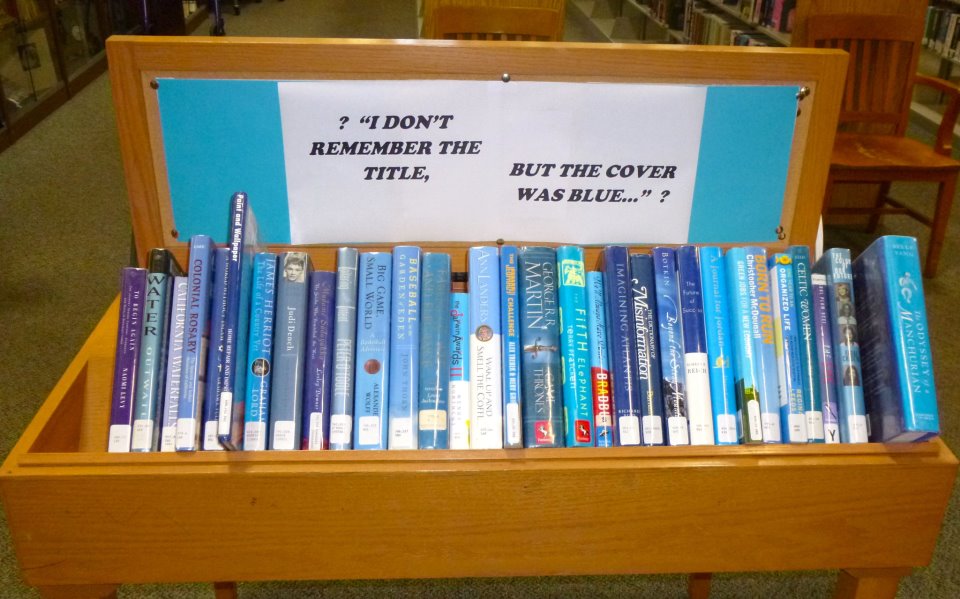
The Problems With Blue Book Covers

Are you kidding me?  That's part of the reason I've got that as my blog title...

Anyway, I'm not the only soul accused of hit and run uh the only librarian to notice the request for books by blue covers!


This is happening, people.  IT'S BEEN HAPPENING FOR YEARS.

WITNESS IT, BELIEVE IT.  This is everywhere:

This was actually from Blue Willow Bookshop in Houston.
THERE ARE BOOKS WITH BLUE COVERS EVERYWHERE.

Be afraid.

I will be adding one more.

Saturday, February 21, 2015

Looking For Science Fiction That Book Clubs Enjoy Reading

Bartow Public Library is starting up our local book discussion program.  We're starting off in March with Gillian Flynn's Sharp Objects, considering that a nice draw as Flynn's popularity for Gone Girl is high right now.

But one of the things I'd like for the book discussion group to look at for the future round of titles to read is to look at the books out there that aren't all the same type of fiction works.

If you look at the various organizations/services that help promote book discussions - like Reading Group Choices - nearly every book they encourage are the same.  Personal narratives, coming-of-age, family secrets, romance stories among the fiction titles.  Memoirs, biographies for the non-fiction titles.

I'm talking books like Empire Falls or Water for Elephants or Kite Runner or Snow Flower and the Secret Fan.

Very few crime Thrillers/Mysteries or Westerns or Fantasy/Science Fiction.  I type in a search for Agatha Christie, I get zilch.  Ray Bradbury, nada.  At least Neil Gaiman's listed, but in terms of finding writers or works that are "out of the ordinary" this is a bit frustrating.

While I can probably promote a few authors or titles of recent vintage - Scalzi's Redshirts for example, or Ann Leckie's Ancillary Justice - for any modern Science Fiction to encourage for the reading group, I'm not entirely certain that I can objectively recommend those reads.  I know I have a bias: while reviews are nice, actual input from actual readers would help here.

This is a multi-layered problem.  There's a reason why reading groups go for the "traditional" fiction of books like Kite Runner - your "human spirit" themes, the love stories, the mundane world made tragic or endearing - is because the readers who show up for discussion groups prefer those types of books.  The problem is that such reads get dull or repetitive: it does not draw in a niche readership that might like dragons and aliens and smoky noir and speculative thoughts.

It'd be nice to mix it up a little.

So I'm sending a message out to the seven people who follow this blog: any suggestions along the lines of a Fantasy or Science Fiction novel published the last three or four years that would appeal to a public library discussion group?

Wednesday, December 24, 2014

Witty's Year End Book Review 2014

It's December 24, last year I did this on that day and today seems like as good a day to do it as well.

The rules are simple: these are from the books I've read - sometimes re-read - during this year.  While I kept it last year to current books - in honor of having a job again in a library filled with books - this year I feel I can go back to the books I've re-read as part of the review.  Hope you don't mind.

Best Fiction

Ancillary Justice, Ann Leckie

I've made a decision to try and get into new science fiction authors, as waiting on anything new by Douglas Adams, Ray Bradbury, Iain M. Banks or Arthur C. Clarke is going to be a bit of a problem.  I saw this title as a Nebula award winner and so made the jump.
Breq is the only survivor of a missing, possibly destroyed sentient spaceship of which she - and gender pronouns get to be an issue as the story progresses - was mentally part of, meaning half her memories and identities are a mess.  She becomes embroiled in a bizarre galactic civil war within Breq's empire that leads to sequel hooks aplenty.  Leckie's work is very similar to Banks' Culture series, with a well-designed 'verse that plays with the conventional tropes of space opera (which means it delves into a mess of human identity issues in-between all the laser fights).  It is one of those books that requires re-reading to make certain you didn't miss a plot point.

Best Non-Fiction

What If? Randall Munroe

The creator of xkcd, a webcomic of absurdist thought, puns, and scientific accuracy, kept getting all of these weird science questions to answer and so started a secondary blog that would answer "What If We Did This?"  Ranging from such crazy ideas as "what would happen if we drained out the oceans" or "what would happen if a pitcher threw a baseball near the speed of light", Munroe applies actual (and sometimes theoretical) physics and engineering to the question to bring up some of the more bizarre - and world-threatening - consequences of such events.
For example, pitching a baseball at the speed of light would cause a nuclear reaction of such intensity that it would wipe out the baseball stadium and the city it was in... and when you throw in the rules of baseball, it means the batter was hit by the ball and advances to first base.
If you want your mind blown, you gotta read this book.

Best Non-Fiction I Praised On My Political Blog


The Selling of the President, Joe McGinniss

As I noted on my Notice a Trend blog: this book was the first one from college I kept, rather than trade back in after my classes were done.  It's short but exposes so much of the sins of our current political culture.  I still feel this is one of those books everyone needs to read once in their lives, if only to realize how corrupt our election/campaigning system has become.  I wrote about the book due to McGinniss passing away this year, and I feel it deserves special mention here.

Best Graphic Novel Series


Sandman: Overture, Neil Gaiman with JH Williams

Gaiman returns to his breakout graphic series Sandman with a prequel tale about how the human personification of Dream, Morpheus, was captured and broken by a dark magus in the early years of World War I (from the first volume Preludes and Nocturnes).  Like all Gaiman works, it hits the tropes early and hard, and can get confusing for anyone who hasn't read the original series back in the 1990s.  But the series promises to answer several of the mysteries and secrets from Gaiman's back-history of his magnum opus, including the reasons why Dream must destroy any dream vortexes that arise among us dreamers...

Best Mystery Anthology That Includes a Short Story I Wrote


Mardi Gras Murder, Sarah E. Glenn (editor)

Another anthology, this time more of a straight up mystery/thriller type tale called "Why The Mask."  It's less "Whodunnit" and more "Howdunnit", about a woman seeking revenge in 1930s New Orleans, but I hope it appeals to the mystery/thriller crowds.


Friday, May 23, 2014

Look What I Found On the New Processing Cart At Bartow Library

Someone's gone and done a YA novel about Library Ninjas...

I oughta be kicking myself though.  I've been thinking up of the need for library ninjas since the 1990s when I wrote my American Libraries humor article about squelching book theft.  Which led into my "Overdue" short story in my Grapefruit Wars anthology...  Shoulda known there could be a market for a full book.

Well played, Downey, well played.

I still got the market cornered on cyborg ninjas battling exploding space penguins...  wait, don't start writing that out!  NO!  MY IDEA, MINE!  Aaaaaaa (rushes off to power-type during this Memorial Day weekend)

Tuesday, February 18, 2014

While I'm Busy Moving, And Working On More Kitteh Pictures, Some Library-Related Stuff

For example, if anyone is starting, joining, or maintaining a book club - READ MY BOOKS cough - you might wanna check out OnTheBookcase.com by Reading Group Choices to see what books are out there that are being used by book clubs, complete with some questions/discussion materials and reviews.

Wouldn't hurt to sign up with Goodreads.com either and see about adding reviews to books you've read or need to read.

Tuesday, December 24, 2013

Witty's Year End Book Review 2013

With almost a full year clocking as a full-time librarian again surrounded by books, books, dvds and more books, it's about time I finished up for this calendar year and promote another year end book review!

To be fair, the rules have changed: during a period when I was out of libraries and relying on my own time and pace for books worth reading/promoting, I pretty much covered any title I'd read over the years to fulfill the Best Fiction, Best Non-Fiction, Best Graphic Novel et al.  This time, I had a whole library to work with (insert grin here), so this time I will focus on the books released this 2013 for once.

Best Fiction


The Ocean At the End of the Lane, Neil Gaiman.
Ever since the Black Orchid 3-parter really, I've been into Gaiman's literary style: knowing the fantasy tropes of superheroes as well as magic, playing and deconstructing stories and then putting them all back together again for the sake of the story itself.  Although Mike Bruscell had to remind me when Sandman came out it was the same author and worth pursuing.
Ocean was the first book in a few years that was geared more for adults - Gaiman's last few were juvenile/young adult - and it's a flashback-based tale of a mid-40s man returning to the place of his youth drawn by a re-emerging memory of what happened when he was seven.  A lonely young boy who gets befriended by a girl living on a farmhouse with her mother and grandmother who talk nonsensical (anyone familiar with Gaiman knows the trope he's playing with here) but who are at least the only other ones aware that an inter-dimensional monster has arrived in their corner of the world.  While this monster is disruptive, it's easy to deal with... problem is that monster causes a mess that brings nastier monsters into the world to clean up...
All of Gaiman's favorite tropes are on display here - the love of cats, the vastness of the universe, the magic of perception, the monsters that try not to be monsters but just can't help themselves - as well as a sense of this being a personal tale, related very much to the author's own childhood and to a sense of loss when that childhood ended.  It's a very good book to read.
Also, when I named my new cat Ocean... well when you read the book you'll understand why.
Runner-Up (I think I do this once in awhile): The Human Division, John Scalzi


Best Non-Fiction


The United States of Paranoia, Jesse Walker
I get into conspiracies, but for all the right reasons...  Growing up I read books about UFOs and ghosts and the Bermuda Triangle and Loch Ness Monster, the strange and unusual, upon which I noticed the bits of conspiracy and cover-ups surrounding some of the events.  By my middle-school years I had "graduated" to more serious stuff like JFK's assassination and the Church Committee findings.  While reading these conspiracy theories I quickly grew to recognize the folly behind a lot of them: some of the conspiracies get so convoluted in their setup and explanations, and relied on thin wisps that half the time weren't even real, that they made little or no sense (sometimes the simplest explanation is the correct one).
This year Walker came out with a book reviewing the prolonged, twisted history of conspiracy thought in the United States itself: the fact that even since our colonial days, our society has been fearful of "the outside threat", the shadow figures below or above us, the belief that someone or some group had it in for our own, for our nation and communities.  Walker does his best to explain the mindset of how perfectly rational people would believe irrational conspiracies: the make-up of the American mindset that allows us to handle the real world while believing that alien shapeshifters from the moon Europa are harvesting our ova.  At least, Walker tries to explain: I think it's all a plot... yes a plot...

Best Graphic Novel


Hyperbole and a Half, Allie Brosh

It's not the most beautifully drawn work in the universe, but Brosh writes in a clear, refreshing, horrifying fashion.
Taken from her ongoing blog, each chapter delves into a particularly unusual moment during her life or delves into particularly painful observations.  Above all, for me, are the moving two-parter chapters she writes about her chronic depression: arguably the most insightful, illuminating description of what depression is really like and why it is so hard for those of us enduring it to ever explain it to people who never experience it.  Where the character representing Brosh describes the emotional void/distance that overwhelms you... the flatness of your emotional state itself... Look, these words I'm using barely even describe it right.  Brosh's words do.

Saddest Thought That is Going To Bother Me Forever


Elmore Leonard is dead and I'll never find out if Foley and Sisco ever get back together.

Best Humor-Horror Anthology That Includes A Short Story I Wrote


Strangely Funny, Sarah E. Glenn (editor and submitter)
Okay, so I'm shilling my stuff!  Glenn and co-editor Gwen Mayo were kind enough to add "I Must Be Your First" into the first anthology printing from their Horror & Mystery LLC publisher.  Some of the stories I found very good - "Best of Taste" by Edward Ahern, "One Scareful Owner" by Catriona McPherson, "Criticus Ex Machina," by Glenn - and some of the others very dark and unsettling.  Some of the online reviews on Goodreads have been okay... but I'd... we'd like to get a few more... especially with 4 or 5 stars attached!


Tuesday, December 11, 2012

Witty's Year End Book Review 2012

To the seven people still reading this blog who aren't Chinese spammers (by the by, they kinda dropped off when I imposed the register-to-comment rule): It's BEST BOOKS TIME.

To re-state the rules: These are not books published this year that I think are AWESOME AND COOL.  Some of these books may have been published ages ago.  It's just these are the books I've read this year that I feel are deserving of the AWESOME AND COOL labels of labeling.

One thing to note: I've been reading more and more in ebook format on my Nook Color.  Yes, even graphic novels are now available in ereader format, so...

Best Fiction Book


Raylan, Elmore Leonard
Leonard is the master of simple prose crime thrillers.  He started off writing westerns but soon turned to modern noir (there is, oddly, very little difference between the outlaws of the Wild West and the outlaws of the urban streets) and hit it big writing about desperate violent criminals and cops in places like Detroit and Miami.  Raylan is a novel dedicated to one of his minor cop characters turned into prime-time television superstar: a US Marshal reassigned to his home county in Kentucky after a questionable shoot-out in Miami.  The beauty of Leonard's work is the vivid characterization for even the smallest role: his criminals (even the college-educated ones) tend towards stupid and reckless, but you can see how and why they think the way they do.  And even the most stupid of them are capable of a moment of pure clarity and profound thought... right before they do something even dumber that gets them caught or dead.  Raylan himself is not a white-hatted good guy - even though he wears an iconic beige cowboy hat - but he is at least the most sane character running around shooting up half the countryside.
I got into reading Leonard while working in Broward County libraries - during the period a lot of his books were getting turned into shows and movies - especially falling in love with his book Out of Sight (alongside watching the film of said book, it is one of my favorite non-scifi movies ever).  I watch Justified - the television show this novel is a spinoff of, expanding the fictional universe of Harlan County - enjoying the characterization and depth of narrative.  The novel is akin to reading short stories or episodes not produced for the screen, in Leonard's perfect style.

Best Non-Fiction Book


Reconstruction: America's Unfinished Revolution, Eric Foner
Once you finish reading McPherson's Battle Cry of Freedom, you need to read Foner's Reconstruction covering the aftermath of the Civil War and the sorrows and miscues that befell the nation.  Documenting the failures of the North to ensure the rights of freed ex-slaves right after the war ends - due to Andrew Johnson's reveal to be more interested in retaining the southern power structure (Johnson hated slave-owners more for their aristocratic airs than for their ownership of humans) - up to President US Grant's struggles to stop the Klan and cope with corrupt state-level Republican governance, Foner notes where the failures took place and why: above all a level of expediency and short-sightedness on the part of Northern politicians who quickly found the rebuilding efforts of the South too time-consuming and divisive among voters back north.  If you want to understand why we had 100 plus years after the Civil War of southern historical revisionism, Jim Crow humiliations making blacks into second-class citizens even with the Thirteenth, Fourteenth and Fifteenth Amendments in place, and why we've still got serious problems with racism in the United States to this very day... you gotta read this history.

Best Graphic Novel


I've read several but haven't really felt the need to compliment any of them by declaring them "best."  My big problem right now is that the universe I follow - DC - is undergoing yet another universal revamp called "The New 52" aka Nu52.  A lot of it has to do with what I call "Universe-Shattering Crossover Fatigue" where every year the comic book universe is rocked with earth-breaking catastrophes in which heroes die, heroes get reborn, and any recent continuity changes get rewritten just to satisfy a minor faction of head editors who want things done their way without realizing how bad their changes are gonna be.  Batman for example getting a never-before-seen secret conspiracy known as The Court of Owls even with 80/40/20 years of established history never once hinting at such a thing.  It gets tiring, all these EPIC re-inventions.  For once I want stories of honest-to-goodness one-issue-length, no more 12-issue storyarcs, no more vast ground-shaking revelations, no more what-the-hell plot twists.  Give me comfort food for a year, people, just stop with the "what a twist" stupidity.

Best Book By Someone I Know And Correspond With On a Regular Basis


Sheryl Nantus has been busy this year, I'll tell you what.  She's got Heroes Without, Monsters Within finally up for sale as her follow-up to the Blaze of Glory novel I recommended awhile back.  I haven't gotten it meself yet, but I should be getting a few BN.com gift cards for the Nook this Saturnalia...

Tuesday, December 20, 2011

Best Reads of 2011 AKA Witty's Reviews

Due to the continuing unemployment, I haven't indulged in a lot of reading or purchasing of book titles.  It's a good thing the public library is nearby (hi, Centennial Park crew!) and I was able to snag a few titles of fiction, non-fiction, graphic-novel, and whatnot for review today:

BEST FICTION BOOK

Hurricane Punch, by Tim Dorsey.
As mentioned before, it's not what's new I'm reviewing but something I've read this year.  And this year, during a nice phase where certain ebooks were for sale, I added Dorsey's eighth Serge A. Storms novel to my Nook Color.
I've might have mentioned the Serge series previously: it's about a seriously deranged enthusiastic promoter of Floridian tourism - Serge, natch - who travels about the Sunshine State obsessing over some new trivial matter about the state, leaving chaos, bodies, and sexually satisfied women in his wake.  Hurricane Punch is an interesting insert into the series, where Serge is facing certain realities: he's hitting middle-age, he's getting to that point in his "career" where serial killers start making mistakes, and he's facing competition in the form of a mysterious new psychopath calling himself "Eye Of The Storm" and mimicking Serge's killing style.  Equally distracting is that Florida is facing another hurricane season and Serge is desperate to track every single one...
While morbid black comedy isn't everyone's cup of coffee, the Serge series is still entertaining at least to this long-time Florida resident for the sheer level of trivial details that Dorsey throws into the stories.  The local culture of hurricane response, the fact that Tampa Bay still has two strong newspapers when most media markets are down to one, stopovers at key locations such as Yeehaw Junction...  Tasty tidbits in the larger story.
Naturally a lot of the novel leaves a lot to coincidence and contrived wrap-ups, but in terms of humorous thrillers I recommend this book and the series as a whole.


BEST NON-FICTION BOOK

All apologies, but failed to read one that I feel good about recommending.  Read mostly technical, computer science titles for skills refreshing.

BEST GRAPHIC NOVEL

Brief Lives (Sandman), by Neil Gaiman and Jill Thompson
The bad news this year was that a bookstore chain, Borders/Waldenbooks, went out of business.  The good news, it meant fire sales where graphic novels got to be 50 percent to 60 percent off.  What that meant: I got around to beefing up my Sandman graphic novel collection.
Brief Lives is perhaps the crux of Gaiman's entire arc covering the decline and fall of the Endless Aspect of Dream.  What happens here is that Dream's youngest sister Delirium - an unstable aspect of life - suddenly gets in her head the idea of finding "their lost brother", an Aspect that abandoned his duties, and she petitions all of her siblings until she guilt-trips a distracted and unamused Dream into helping her find Destruction.  And then Dream has to say to his aide, "What could possibly go wrong?"
This particular volume has a lot to say about Life Itself: how we perceive it, how it flies by, how we define it... and sad of all, how brief life can really be.  As Destruction, once found, points out during his evening confrontation with Dream and Delirium, even the stars in the night sky do not last and will flicker and end.  Even the Gods and Immortals we meet during Delirium's quest must face an end of their travels.  Or, as Death tells one character during the story "Everyone gets a lifetime's worth."
It also has one of my favorite story endings ever, both apt and bittersweet.
I've been a huge Gaiman fan since this series came out, and I seriously feel this is required reading for anyone getting into it now.

BEST NOVEL BY SOMEONE I KNOW VIA THE INTERNET

Haven't read any of the recent Stefan Petrucha stuff or Sheryl Nantus', although Sheryl is coming out with a sequel to Blaze of Glory titled Heroes Without Monsters Within next month...

UNAVOIDABLE BOOK FRANCHISE OF DOOM

Anyone else notice how James Patterson is putting his name on a lot of books that seem to be written by other people?  Yeah, Tom Clancy kinda does the same thing.  But Patterson puts his mug on television ads shilling the works...

Hopefully by next year I'll have a job and a restock of my reading collection.  Til then...

Wednesday, April 13, 2011

Negotiations For A Cover Artist

It helps to be a comic book fan and to follow links on DeviantArt to those artists who take commissions... ;-)

Wednesday, February 2, 2011

Feb 5th: Local Authors Event at Barnes and Noble Wesley Chapel FL

I will attend the Local Authors event at the mid-Pasco Barnes and Noble store in Wesley Chapel, FL, this Saturday Feb. 5th from 2 pm - 4 pm.  Its at the Shops at Wiregrass Mall, 28512 Paseo Dr.  It's off of State Rd 56, east of the I-75 intersection along the Pasco-Hillsborough border.

I will be marketing my collected shorts anthology Last of the Grapefruit Wars, and will see about advertising my recently released estory "Welcome to Florida".

Please attend.  I need a few people to show up and scream like I'm a Beatle.  :-)

Tuesday, December 14, 2010

Witty's Year End Book Review 2010

Another year of unemployment, more time to stress out and read books to calm down...

To re-state the rules: These are not books published this year that I think are AWESOME AND COOL.  Some of these books may have been published ages ago.  It's just these are the books I've read this year that I feel are deserving of the AWESOME AND COOL labels of labeling.  And for the Chinese Spammers who try to leave ....... comments in my comments field, there's a chance they might notice a title and read a book and BE CORRUPTED FOREVER BY MY WESTERN CULTURE IDEALS BWHAHAHAHA.  Okay, maybe not, but here goes.

BEST FICTION BOOK

Snow Crash, Neal Stephenson
This is a cyberpunk novel that's been out for less than two decades (published 1992!), but I'd heard good things about it and never got a chance to find a copy to read.  Well, with the time on my hands now...
Snow Crash involves Hiro Protagonist (yes, that's his name) living in a 21st Century Los Angeles future world where corporations (some having merged with crime families) control everything... even to where people's names are trademarked.  After losing his job delivering pizza for the Mafia (it's there in 20 minutes OR ELSE), Hiro teams up with the girl YT (Yours Truly) - who's partly to blame for that job loss - to hire themselves out as a hacker/intel to the privatized CIA.  They quickly uncover a dangerous new drug - Snow Crash - that's part computer virus and real-life virus that's infecting more and more citizenry.  It all has something to do with Sumerian religion, self-made gods, and a quest for a universal language that can enslave us all...
What makes the novel fun is how it's both standard cyberpunk - the computer universe and its anarchistic hacker culture - and post-modern thriller. Post-modern meaning self-awareness.  Hiro is fully aware of all Internet Traditions (even though this book was written before any serious traditions were forged!), and also fully hip to the tropes and memes of heroic narrative.  His description of Raven also explains the Badass so well it's what the Tvtropes.org website uses to open their Badass entry.

BEST NON-FICTION BOOK

 Battle Cry Of Freedom, James McPherson
If not the definitive work on the American Civil War, most likely it's in the Top 5.
Political blogger Ta-Nehesi Coates hosted a book reading club online for 2010 on this work, and I had chimed in with my comments, observations, and witless retorts.  Index here on all of TNC's Civil War entries, by the by.
McPherson goes into excellent detail about both the causes of the Civil War (Slavery, slavery, Southern financial and political elites eager to maintain the status quo, and oh yeah slavery) and the battlefield conflicts themselves.  Switching from one chapter that investigates and highlights the political, economic, and cultural changes that the war brought upon the nation; to the next chapter that describes the carnage, confusion, and wartime heroism of each major battle (Shiloh, Gettysburg, the Wilderness, Petersburg) and the generals who mismanaged it all.
It's a must-read for all Americans.  Even the ones who don't like history.  You need to read this because, by simple comparison of the rhetoric of the Southern Slaveowner politicos to the rhetoric of today's Far Right conservatives, you'll realize we're still fighting that damn war...

BEST GRAPHIC NOVEL


JLA/Avengers, Kurt Busiek and George Perez
This had been out for a few years, and in fact had been on the drawing board for decades (back to the mid-1980s when the comic business exploded into mainstream culture), but I had finally gotten around to reading the collected series this year.
Comic book crossovers are nothing new.  In-universe, they happen all the time (especially as a guest appearance by a popular character - Batman - could boost sales for a struggling title).  Crossing universes, however, are obviously trickier: companies are wary of losing any creative control over their characters, and crossovers between universes have a habit of ignoring certain continuity in order to justify its plot.  Sometimes, a writer unfamiliar with the history or traits of a character can derail everything both within the crossover's story and back in the established continuity that could well kill off a character's popularity for good.  This is, by the way, what happened when DC and Marvel did create a crossover event called DC Vs. Marvel in the mid-1990s that created a convoluted and ridiculous Origin Myth for both universes, set up characters to fight each other for no real reason or resolution, and ended up entertaining NOBODY.
JLA/Avengers did it right.
Taking the primary superhero teams of each universe - Justice League of America (DC) and The Avengers (Marvel) - the story involves a DC galactic villain Krona who travels from universe to universe in a quest to understand how universes are created (in order to control such power for himself).  But in order to do that, he has to destroy said universes while studying them.  When he reaches the Marvel Universe, he confronts the first being of any power that can delay him - The Grandmaster, a hedonist lover of high-stakes games - and is forced to accept the Grandmaster's challenge of having universal champions fight each other to claim twelve powerful totems... and they choose the Justice League and Avengers for the game...
Busiek has a lot of fun tweaking the cultures and continuity of each comic book universe as the two teams visit the others' world and clash.  DC heroes are horrified to see how in the Marvel universe that mutants are persecuted and tyrants like Doom left unchallenged.  Marvel heroes are horrified to see that Supers in the DC universe are nearly worshiped as gods in what looks to them like a fascist society.  Marvel's resident speedster Quicksilver is envious of the fact that his competitor The Flash has his own museum.
Impressive also is Perez's artwork: Notorious for drawing elaborate battle scenes and massive gathering of characters (the cover art for one issue was so packed full of superheroes that Perez had to rest his hand for weeks after completing it), this series was quite possibly his best effort since Crisis on Infinite Earths.
The clincher for the series is when the two teams, realizing the Grandmaster's plot had forced their two Earths together to trap Krona - and that the trap is falling apart - find out from the cosmic being the price each hero will pay even if they stop Krona.  As the heroes had reverted to their Silver (Heroic) Age personas of the 1980s, all of them are shocked by the de-railings (and deaths) each character suffered during the Dark (Antihero) Age of the 1990s.  Disgusted by their futures, they nonetheless agree that stopping Krona - who would destroy both universes anyway - has to happen... and they proceed to launch a massive assault on Krona's citadel just as he's carving into the two beings (Infinity and Kismet) that personify each universe...
As a comic book fan, this was a decent read.

BEST BOOK BY SOMEONE I KNOW AND CORRESPONDED WITH VIA EMAIL ON AN OCCASIONAL BASIS 

I'm gonna need to get back to you all on this one, I haven't made up my mind between Sheryl Nantus or TNC or...

Tuesday, March 23, 2010

Ten Books That Influenced Me the Most (Updated 2015)

(updated 12/23/2015, see below)

Picked this up on Sullivan, floating about the other blogs:

Tyler Cowen lists the books that have influenced him most and encourages other bloggers to do the same.

Hmm.  Biggest problem for me as both an enthusiastic reader in my teen years and as a librarian for most of my adult life is trying to narrow this down to ten.  I dare say a lot of them are over on my Library Thing page (linkage to the right of the screen, no your other right), but some aren't.

I think I'll list them in chronological order as best I can remember:

Thirteen Tennessee Ghosts and Jeffrey - Around Second or Third Grade I was into the paranormal stuff: UFOs and Ghost stories.  The non-fiction stuff.  There were a few titles on the Dunedin Public Library (this was back when it was in an abandoned Publix storefront) and this book I kept reading over and over.  It introduced me to the Bell Witch legend, for one thing.  It made me wonder what had happened to Merriwether Lewis (whose ghost was supposedly scraping at a water bucket ever since his mysterious death).

Han Solo at Star's End - okay, so it's not the Dune or Foundation series, which I also read at the time (between Second and Fifth Grade).  But I ain't gonna suck up to all seven people reading this blog and list 'classic' works and get all mopey and philosophical about the profound literary intents of Asimov and Herbert.  You get the trashy stuff I like dammit!  I grew up to Star Wars: these pulp paperbacks (such as Splinter of the Mind's Eye) were filling in the years between the films and I liked them.  Star's End was fun and had some pretty mature stuff to it - deaths, betrayal, snarky commentary - compared to the other more juvenile titles available to me at the time.

Hitchhiker's Guide to the Galaxy - The first truly absurdist literary work I came across (Catch-22 was five years later).  The first time I realized that not only does God have a sense of humor but that God was sometimes laughing AT us instead of with us.  What amazed me when I go back to re-read his works were the bits of misanthropy I had not realized back in my youth: the jaded despair Adams had for humanity and our inability to see the problems past our own noses.  The mood shifts explained away via the series' most cynical character Ford Prefect, who knew madness when he saw it and knew the best response was to avoid it at all costs and go to parties instead.  I think that's why most H2G2 fans have a hard time accepting the follow-up book So Long And Thanks For All The Fish: it's perhaps Adams' most optimistic book in the series, or at least ends on a happy note...

Batman: Dark Knight Returns - actually it was Issue 2 of the miniseries, but the collected book itself in the end belongs on the list.  It was in Mr. Henderson's journalism classroom back in oh 1986, during a free period between getting school newspapers together, that I spotted a copy of that Issue 2 sitting on a table.  Not knowing whose it was, I picked it up and read it, fascinated by the artwork and the kinetic detail (I put it back when done, btw).  The more I read it (not just the images: the narration balloons, the dialogue, the words themselves) the more I got hooked.  This was the issue with the fight between Batman and the Mutant Leader, with a girl Robin showing up, the Batmobile literally bursting onto the scene as a tank (!), and the intermixing background noise of the DC Universe's fictional media debating the merits of costumed vigilantism.  I had until then a vague interest in comic books, mostly some beat-up issues me and my brothers bought in paperback dealers, but this was what drew me in.  I sought out a direct comic store from there on right about the time DC went through it's Crisis on Infinite Earth stage.  As they were re-booting at the time it was the perfect moment for me to jump in, and I immersed myself (much to my parents' dismay) with the comics culture for about 10 years.  But by 1996 I started to drift away, the costs of keeping up getting too much and the DC publishers having a very hard time keeping track of their convoluted re-booting.  I've stuck to the occasional graphic novel from then on.

Killer Angels - In hindsight, the novel about the Battle of Gettysburg gets a tad... preachy... but it introduced me to some of my personal heroes, especially Joshua Lawrence Chamberlain of the 20th Maine (seriously, that's how I call him).  One of these days I gotta go visit Little Round Top.

Rosa Luxemburg - we're getting into my college years now, and it's between this and any handful of titles I read for a Literary Utopias class.  Problem there is, I can't recall any of those Utopia titles impressing me too much: like Ferris, I came to realize that -isms are bad and those Utopias all have one flaw.  That utopias are impractical in real-world application.  Actually there's a second flaw with Utopias: the utopian idealist is so intent on creating a model society that any human trait (sins such as greed, envy, lust) that would conflict with that utopia would be ignored rather than resolved, dooming said utopia when that human trait rose up.
So I point you all to a biography of someone I had to read about for another college class, one dedicated to reviewing and comparing/contrasting biographies of famous Great Men of History.  I had Churchill, FDR, and Rosa Luxemburg.  Talk about your contrasts.  The first two guys would agree to the Great Man theory of historical thought: Luxemburg being a hard-core communist (international communist, not the Leninist types that dominated the 20th Century) would have argued more for a People's History where the flow of history came from the masses desiring change (in truth, it's a combination of the two: people push for change, but it takes the right leadership to focus that power in the best possible direction).  One of the things I did get from reading the biographies on Luxemburg was that the communist movement wasn't entirely focused on Lenin and his Soviet cronies: there were other commies who disagreed with Lenin's motives and ambitions.  It helped to read up on communist and socialist theory that wasn't tainted by Leninism... and still see the flaws inherent in communist theory.  Leninist party rule led to corruption; Marxism itself oversimplified economics and class systems, and failed to recognize future trends that would lead away from industry and capital superstructure: those factors would lead to its failure at the end of the 20th Century.
There were about three biographies I relied on for the research: I'm pretty sure one was by Frolich, another by Nettl.  The third one might have been Ettinger.  Most of what I got from reading on Luxemburg was sadness of a sincerely-led life gone to waste.

Sandman: Fables and Reflections - part of my comics reading focused on the... macabre literature that DC was publishing that would lead into their Vertigo brand: I had begun reading Swamp Thing just as Alan Moore was leaving it, and from Swamp Thing I picked up the spin-off work Hellblazer (aka the one with the trenchcoat badass Constantine).  A third one began at about the same time: Sandman, which started off as yet another horror-themed series but by the second "volume" began shifting into more high fantasy plot lines.  Where the replacement writers and artists for Swamp Thing and Hellblazer thought it was all about the shock value (and where the artwork for Swampie went into questionably bad pencil/inkwork), Sandman retained high production value especially as one writer - Neil Gaiman - was in charge of the narrative.  No one else wrote a Sandman story.  Over the years Gaiman stuck to various themes, guiding the story lines to what was recognized by fans as a fixed ending - the fall of the Dream Lord - and providing a satisfying conclusion to the series.  Few other comic books - excuse me, graphic narratives - could claim to aspire to high-quality literature (the closest I could suggest would be the Love And Rockets / Palomar series by the Hernandez Brothers.  Dave Sim tried with his Cerebus but it drove him mad).
This particular volume I'm promoting - Fables and Reflections - is a sort of short story collection: in-between the epic story lines Gaiman wrote - Doll's House, Season of Mists, Brief Lives, Kindly Ones - were one-off stories of various characters affected by their dreams and the decisions they made whilst dreaming.  Fables and Reflections collected the ones printed before and after Brief Lives (Gaiman's meditation on mortality, loss, and responsibilities), and included stories of regular people (sort of) and famous historical figures (Augustus the first Roman Emperor, Harum al-Rashid the caliph of Baghdad at its height of legend, Robespierre of the Reign of Terror, Marco Polo the traveler and historian of Kublai Khan).  Among the famous historical figures is Joshua Abraham Norton, a expatriate businessman in mid-19th Century San Francisco who loses his fortune... and through the manipulations of the Dream Lord Morpheus playing against his Endless siblings finds his calling as Norton I, Emperor of the United States.  It was Gaiman's tale that introduced me to the Emperor Norton, and after additional readings on him over the years I've come to respect the man.  You ought to read up on him too.  Then call the city of Oakland and insist the Bay Bridge be named in Norton's honor.  Oakland never did like the Emperor... :(

American Gods -  Gaiman gets two entries here.  Oddly enough I don't think he's the best writer I've ever read (that would be Ray Bradbury: pity his best stuff is short stories and they're spread all over the place): he is however the most enjoyable, and the one who has proven to best mess with the established tropes.
American Gods carried over a theme from Gaiman's Sandman work: that the Gods (the pagan ones) are real, defined not by their own existence but by the belief system and legends created by us humans.  It turns out that the United States is swarming with gods brought over from the Old World, but because of how and who we worship anymore the pagan gods have to 'find work' in other professions: Egyptian gods working at a funeral parlor in Cairo, IL.; a nameless god of fortune presiding over a Vegas casino; the goddess that may have been the Queen of Sheba reduced to a call girl; a Germanic death god reduced to near-retirement at a slaughterhouse; and Odin left to playing con games across the nation.  The biggest problem for these aging gods is that the belief system in effect allows for newer gods to be born: a computer geek god, Media as the goddess of television and its' hypnotic, consuming ways; foot soldiers comprised of every conspiracy theory the wingnuts believe in; and more.  And the New gods are convinced they need to destroy the Old gods to claim America for themselves.
The beauty of American Gods is how Gaiman focuses on how legends are born, on how myths perpetuate and how people even need to Believe In Things (even the fantastic, even the cynical) in order to exist in the Real World.  The plot itself is irrelevant: the fun is in the details and the clues.  And like most Gaiman stories, the climax isn't the big battle or the great moral victory (which actually rarely happens in his works), the climax is... well, that would be telling too much.  Just remember this: only the gods are real...

No Plot?  No Problem! - Shameless plug for the NaNoWriMo.

Price of Loyalty - A book focusing on George W. Bush's first Secretary of the Treasury Paul O'Neill, this is a fascinating insider look from a noted business and political figure whose falling out with the Bush/Cheney/Rove crowd was big news.  While O'Neill's early focus in the administration was on getting passage of Bush's prized tax cut package, the later chapters detailing the descent into war-frenzy after 9/11 are chilling.  O'Neill's recognition that the push for an Iraq War required the government to pull back on the tax cuts led to in my mind the most insulting moment in political history: a disinterested, almost nonchalant VP Cheney telling O'Neill "Deficits don't matter."  Trillions of dollars in debt later, Cheney still needs to see jail time for that kind of blase mismanagement and political short-sightedness.
There have been tens of other books published about the nightmare that was the Bush the Lesser administration - Dean's Worse Than Watergate, anything by Glenn Greenwald - but this one by Suskind is more accessible as it has a likable and believable protagonist in O'Neill, whose forays into the world of business (Alcoa executive) provides a surprising amount of humorous moments.

There you have it.  Took me 3 days to pile this list together.  Now, is anyone willing to add my book to their list of influential titles?!  Anyone?  Bueller?  Bueller?!

UPDATE: I should have included this one, which I wrote about over on my political blog.

The Selling of the President - A book about the 1968 Presidential campaign, one of the first to use aggressive television advertising to market a candidate as though he were a new car. Follow the link back to my politics blog to read the full review of it, 'cause it's too lengthy to list here. Thank ye.

Saturday, December 19, 2009

Witty's Year End Book Review 2009

Just as a reminder, this isn't a list of new books that came out from 2008 or 2007, these are simply the best books I've read this year.

Best Fiction Book

Being a little busy in the job-hunting and college-class-taking this year, I didn't get many chances to sit down and enjoy a novel or five.


Best Non-Fiction Book

Presidential Character: predicting performance in the White House, James David Barber.
My college studies at Florida were geared for a Journalism degree, which didn't work out as I'd hoped. But class requirements included a good number of Political Science classes, and in one of them (either a class with Professor David Conradt on comparative political systems, or another class on Famous People which had me comparing FDR, Churchill and Rosa Luxemberg... yeah, go figure) this research by James Barber came up. Barber had worked out a system of psychological profiling for Presidents, based on work histories and biographies of those that came before. He became famous for predicting Richard Nixon's decline/fall during Nixon's first term, and his subsequent reviews of following Presidents (Ford, Carter, Reagan, Bush the Elder).
Barber is responsible for establishing the two measurements for Presidents - Positive/Negative and Active/Passive - creating four types: Active/Positive (constant policy actions, positive and flexible view of Presidential power and decision-making), Active/Negative (Lots of policy actions, but with a narrow, inflexible and sometimes corrupt view of power), Passive/Positive (little initiative, relying more on Congress or on society as a whole to go their way, but eager to provide leadership as a statesman or captain at the helm), Passive/Negative (very little true initiative, only leading out of obligation). Interesting side note: the first four Presidents on the list - Washington, Adams, Jefferson, Madison - fit each type. Quick, figure out which was which. :)
Given my political leanings (and my ever-growing animosity towards certain current-ex-vice-Presidents who ruled behind the curtain) I've been digging around for Barber's work for ages. I finally spotted Amazon selling a 4th edition (textbook for a college course again) and ordered one. Thanks to Barber's book, I've gotten a better understanding of how we should rate Presidents... Bush the Lesser? In my estimates he's a Passive/Negative - more a pawn of other political forces than his own, more intent on the perks of the Presidency than actually leading (enjoying a birthday celebration while Rome burned uh New Orleans flooded, for example). The book also helped nail Dick Cheney (who as you look closer at the Bush the Lesser admin was a true co-President than anyone before him) as an Active/Negative (a true heir to Nixon, which is terrifying).
Hmm, I should leave that for my other blog. But still, this is a great Poli Sci book and a lot of libraries ought to carry it.

I still suggest the No Plot? No Problem! by Chris Baty, as this is vital reading for the NaNoWriMo event.


Best Graphic Novel Series, This Year

Instead of a novel, this year I've taken a liking to a crossover event series.
DC Comics' Blackest Night primarily written by Geoff Johns and penciled by Ivan Reis, is still in production, Issue 5 so far out of 8 issues. And a lot of background is needed here...
Long long time ago, there were major comic book publishers: National/DC and Marvel were just a few. They used to publish their superhero titles with little interaction between their established characters... but then one day Superman teamed with Batman... and then Justice Societies got together... and then the World War ended and superhero comics were attacked for unhealthy morals and everything went to Western and WWII titles... and then superheroes came back, but with new origins... and then the new Flash literally ran into the old Flash and proved there were alternate universes... and then DC heroes formed a Justice League while Marvel started Avengers within the now-expanding comics universe in each publisher's realm... and by the 1980s it all got convoluted because writers and editors with each book weren't keeping up with everyone's else work, and conflicting mythologies and plotlines were cluttering up stories where the fans expected clarity and continuity.
So DC Comics decided in the mid-1980s to rewrite their universe with a Crisis: update it, kill off cumbersome galleries of side characters, streamline the history to make it compatible with the real world, everything. They killed off major characters - Supergirl, Flash - and rewrote existing ones with brand-new origins - Superman, Wonder Woman, Hawkman, slew of others. It got so popular that Marvel countered with Secret Wars as a crossover, and then DC published a few crossovers to keep their universe interactive (and to make money). And thus were the crossover comic events born.
But where Crisis tried to clear up everything, it actually made things worse. Origin rewrites for some characters - Hawkman in particular - were delayed and conflicted with other stories. DC's solution? More crossovers! But in the process, existing characters were re-written again - in particular Green Lantern being turned into a villain called Parallax - and more killed off. In attempts to attract readers, the publishers started more and more crossovers - to encourage purchasers buy multiple titles - and in order to justify the crossovers being MAJOR UNAVOIDABLE EVENTS OF ULTIMATE DESTINY - those crossovers kept killing more and more characters.
But all this character killing created problems. For one, the publishers - both DC and Marvel were guilty of it - were bumping off what proved to be marketable, likeable characters. When replacement characters proved unlikeable, flimsy excuses and retcons were used to bring dead characters back. The biggest publisher stunt ever was the Death of Superman... all because it was too quickly followed by a plotline of multiple Supermen leading up to Supes' all-too-expected ressurection. The other problem with all the superhero deaths was that by relying on it too often as a plot device - oooh, we're killing a character! oooooh, we're bringing a dead character back! - it became too cheap a gimmick. Readers got jaded by all the death to where rather being a shocking, humbling moment in a comic universe's storytelling, it was mocked, parodied, and expected. Everyone now expects a superhero's girlfriend to end up in a fridge... which is both sad and sick. Oh, by the way, they killed Captain America a few years ago... and where the mainstream media made a big deal out of it, fans knew he was coming back sooner rather than later... Oh, and Batman's dead too. Yawn.
Which leads up to Blackest Night. Written by Geoff Johns, currently the guy responsible for the destruction of DC Comics, Night is playing off the threads of ideas than ALAN MOORE HIMSELF toyed with back when he worked for DC in the 1980s. Moore had during his brief stint there tossed out idea after idea that deconstructed, rewrote, and expanded the superhero mythos in ways you couldn't even imagine... and almost all of it never happened. Twilight of the Superheroes remains one of the best-known "lost" works in popular culture, with only bits and pieces - the Armageddon 2001 crossover, the Kingdom Come Elseworld miniseries - emerging as bastardized versions. Night is playing off a storyline Moore created for a Green Lantern anthology, wherein legendary Abin Sur is confronted with prophecies regarding his eventual death and the fall of the Green Lantern Corps itself. It was Moore's attempt to explain why Abin Sur was flying a spaceship when Lanterns are perfectly capable of flying solo: the prophecy weakened Abin's faith in the ring, and paradoxically led to his death (allowing the ring to pass to Hal Jordan of Earth). Johns read the story, and decided that the other elements of that prophecy - namely, the fall of the Corps (which would mean the fall of the universe) had to be played out. Hence the coming of Blackest Night.
Johns has basically, over the past 5-7 years, been revamping the entire DC Universe yet again, trying to undo the wreckage caused by Crisis on Infinite Earths by bringing out more Crises after another - Identity Crisis, Infinite Crisis, Final Crisis. Each one actually killing off more characters than before, infuriating readers with bizarre character derailments, bringing back dead heroes with more bizarre explanations, each one actually causing MORE damage to an increasingly unworkable multiverse.
But it turns out Johns might have planned this all along. Make things worse in order to make things better... and so far the idea is bearing interesting fruit... Because it might fix the problem with comic book deaths once and for all.
Night is basically Johns' answer to all the comic book deaths we've suffered over the last 40 years, in fact. Every character killed during the past series of Crises are RISING from the grave, but as zombies... No, wait, while you think "Hey it's been done" this time these zombies are different. Powered by Black Lantern rings (a whole rainbow of Lanterns have exploded on the scene), the undead superheroes are attacking their still-living colleagues by provoking emotional responses... using the moment of peak emotion to kill their prey and in true zombie fashion turn the fallen into more Black Lantern zombies. All in an attempt to resurrect a Death demon called Nekron... who seeks to destroy the emotional light of the universe (basically ALL LIFE) to return all to the black void. Deal is, Nekron just revealed he is not only powering the newly dead, but that he had a hand in allowing previous heroes - Superman! for example - to return from the dead with Nekron's taint... meaning they all Came Back Wrong... From what I'm gleaning off the plotline, Johns is seemingly wiping the slate clean, bringing back ALL dead heroes (and villains) for the purpose of this miniseries, and then using the mechanics of the Black Lantern's strengths and weaknesses to hammer out a method in the future (once all is set right) of killing certain characters and giving them an out of getting resurrected later.
What's enjoyable about this miniseries is that finally someone is looking at the bigger picture of how haphazard the universe-fixing attempts were, and how stupid and eventually fan-crushing the whole Comic Book Death meme has played out the last 15-20 years. Just as long as Johns gets it to make sense in the last issue...

Unavoidable Book That Spells Doom for Humanity

There's actually been a lot this year: all of them far right screeds. All of them wrongly made best-sellers (more out of marketing and fan-driven quantity than actual quality). I'm not linking to any of them. Suffice to say, just avoid the Personal Narrative political bio/philosophy titles for the past 3-5 years. You'll thank me.

Best Book by Someone I Know and Corresponded with via Email on an Occasional Basis

Kinda hard to list one this year: being out of the library profession, I haven't kept up with Petrucha's latest. I do know Nantus is getting a second book reviewed in the galley stage, meaning a print release soon. 'Course, I've been busy meself...

Tuesday, December 15, 2009

NaNo Update 12/15/09

I'm finishing up the novel, but now without the deadline - and with an A+ Cert exam I gotta cram for due next week - I'm finding it hard to keep up with the pace I had in November... sigh.

Meanwhile, I'm looking at creating another Best Of year-end list... with a few changes.

Saturday, July 11, 2009

Why Harry Potter?

In 1997, based on a search in OCLC WorldCat, there were 83 English language books written about magic that would be considered Juvenile fiction (search term - Su: Magic Juvenile Fiction).

One of those books was Harry Potter and the Philosopher's Stone, published in the UK. The US market would get the book in 1998 (retitled with Sorcerer's Stone), published among 90 such fictional works.

This book would go on to sell 300,000 copies by 1999 in the UK and roughly 11 million (hardback AND paperback) in the US; top bestsellers lists; spawn a series of equally mass-selling books - nay spawn an entire industry of toys, foods, and other books; get made into blockbuster movies; and basically turn childrens' literary publishing into a financial behemoth as hundreds of other would-be Rowlings scribbled out pale imitations to cash in (with only a handful - Lemony Snicket comes to mind - showing any originality deserving our love).

The deal is, why? Why this book? What was it about the first Harry Potter book that made it so popular?

The reasons why are that firstly Rowling created memorable characters and memorable settings, and secondly like any good author Rowling stole (c'mon. Every artist a cannibal, every poet a thief...) from the good and/or great storytellers that came before.

The earliest comparisons Rowling got were to another well-known children's author, Roald Dahl, whose classics (Matilda, James and the Giant Peach, Charlie and the Chocolate Factory) were detailed child's-eye-view-of-the-world tales replete with adult (and child) grotesques. Are there any true differences between Matilda's uncaring parents the Wormwoods and Harry's Aunt Petunia and Uncle Vernon Dursley? Draco Malfoy and Veruca Salt are practically siblings (hate to think of them as boyfriend/girlfriend shudder. Oh God I hope there's no fanfic on that). Dolores Umbridge and Mrs. Trunchbull have to fight it out as Worst Teacher Ever. These characters are archetypes: bad parents, spoiled children, officious and uncaring bureaucrats, and all of them bullies to boot. Note too the detail of names, how they roll off the tongue as literally defining each character and yet made colorfully off-beat.

Rowling also borrowed heavily on a form of literature better recognized in England than in the US: that of the Boarding School coming-of-age tales. Such tales were prevalent when boarding schools dotted the British landscape, mainly the Victorian and Edwardian periods. Post-WWII era with a decline in such schools being replaced by regular public-funded schools also meant a decline in such stories, replaced by standard coming-of-age tales. Boarding school stories focused on basic themes: friendships made, bullies defeated, sporting events won. Said sporting events usually cricket or football (no broom-riding sports I'm afraid, old bean).

It might surprise, but Rowling also steals from a British author more popular than her: Agatha Christie. Potter books are - for the most part - plotted like murder mysteries: Whodunnit? (also How'd They Do It? and Why'd They Do It?) Who's stealing the Philosopher's Stone? Who opened the Chamber of Secrets? Why after 13 years is Sirius Black coming after Harry Potter now (or is he...?), and how is he doing it? Who really betrayed Harry's parents to Voldemort? Who put Harry's name in the Goblet of Fire? What's Voldemort want with the Department of Mysteries? Who is the Half-Blood Prince? What are Horcruxes? And the most important question of all: When will Josh and Donna make out? Oh wait wrong fanfic obsession... And that was resolved halfway through Season 7 anywho, but I digress.

Last but not least, the real reason Harry Potter sparked so much interest: Rowling followed the basic rules and plotlines of the Monomyth. And while Joseph Campbell's critics can argue that over-reliance of the monomyth as simple plot structure has led to a lot of crappy fiction, you can't argue when it's done right (Star Wars, the Matrix, even Star Trek). And Rowling gets it right. It also doesn't hurt that she follows a lot of fantasy-themed elements set down in The Encyclopedia of Fantasy, a reference that was in the works just as she published the first Potter book.

She created foremost a world that is both mundane but magical. Obviously, she created a Hero (Harry Potter) but also loyal Companions (Ron Weasley and Hermione Granger) who provide the Hero with vital tools: Ron gives Harry access to the Weasley family who act as advocates and guides to a Wizarding world he's unfamiliar with (as well as providing a surrogate home the Burrows) while allowing Ron opportunities to shine separately from his successful older brothers; Hermione provides knowledge and problem-solving skills that otherwise would lay dormant. There are additional Companions as well, notable among them Hagrid, Neville Longbottom and Luna Lovegood. Harry has his Mentor in Albus Dumbledore, although Remus Lupin and later Sirius Black provide Mentoring as well. And there's the Pariah Elite formed as the Order of the Phoenix, the wizard resistance formed to fight Voldemort and his Death Eater minions. And Snape... I'm tempted to place him as a Threshold Guardian, but arguably as the most complex character Rowling created pinning Snape down to any one Role is tricky. One more obviously is that Rowling created a Dark Lord (literally) in Tom Marvolo Riddle AKA Lord Voldemort, who threatened both Wizarding and Muggle worlds (The Land) with Plight... and like all Dark Lords he may be powerful but can be maddeningly blind to obvious flaws in his various plans to rule/destroy the world. Voldemort violates Rule 6 nearly every book he appears. Sheesh. Oddly enough, Voldemort never evens tries to violate "Rule 34. I will not turn into a snake. It never helps."

With the pieces in place, she follows most if not all of the monomyth rules faithfully: the Call to Adventure comes with that first letter from Hogwarts (addressed to the abused Harry's "Cupboard Under the Stairs"). The Refusal of the Call isn't Harry's fault: his aunt and uncle despise Wizardy and hoped by abusing Harry they would crush it out of him. Supernatural Aid comes via Hagrid who ensures the Call to Adventure is heeded, and Hagrid is the first to escort Harry into the Wizarding World (Diagon Alley) and help him locate tools (Wand, Owl, School Supplies) to assist in his survival. The Crossing the First Threshold and the beginning of the Road of Trials are basically Harry's first journey to his new school Hogwarts, during which he meets his Companions (Ron, Hermione and Neville) as well as Enemy/obstacle Draco Malfoy who acts as a bully and minor threat for most of the overall series. Draco is merely a representative of the True Threat Voldemort, reflecting Voldemort's bigotry and sadism but unable to truly achieve the malice of his Dark Lord. Past this, the book series is replete with Thresholds to pass and overcome, and various Belly of the Whales that Harry must survive: Entering the final chamber to confront the person stealing the Sorceror's Stone; Entering the Chamber of Secrets to save Ginny; Entering the Shrieking Shack to save Ron and confront Sirius Black (and the Truth and Atonement with the Father that Sirius represents); Entering a labyrinth that would lead to Voldemort and the Death Eaters at the end of the Third Trial of the Triwizard Tournament; Entering the Department of Mysteries to rescue Sirius Black but instead facing a trap; Entering Tom Riddle's childhood cave to recover a Horcrux; and with the last novel Entering an otherwise impenetrable goblin bank to steal a Horcrux, Entering the Room of Requirement to locate another Horcrux, and Entering the Forbidden Forest to finally confront his own Death (?) at Voldemort's hand. That's a lotta whale bellies.

There's Apotheosis with Harry's self-sacrifice at Voldemort's hand in the final book, but that leads to the Boon, the wisdom and knowledge gained in the Afterlife. With the Boon (knowledge that Harry is no longer a Horcrux, and the realization that Voldemort doesn't have true mastery of the Elder Wand) Harry considers for a moment the Refusal to Return, then acknowledges he must Return to bestow the Boon to everyone else by destroying Voldemort once and for all. He returns to the mundane world but is Master of Two Worlds (the World of Magic and the World of the Afterlife), and exults in his Freedom to Live by showing he was and remains unafraid of Death, unlike Voldemort who fears Death and is destroyed by his own Killing curse.

There's probably a more detailed way (probably a whole book) of fitting the Harry Potter series into the Monomyth structure (I didn't even touch on the Goddess stuff), but the point is Potter-as-Monomyth works. And despite all the complaints about the Monomyth, it DOES create easily-read, easily-recognizable tales that appeal across the broad spectrum of storytelling (well, at least within Western/Eurocentric Literature). That's why Harry Potter got to be so popular 10 years ago, and why it's still popular today, and why it may yet remain popular 100 years from now.